
ESAB industrial welding equipment logo
Application desk

Contact ESAB with a Reviewable Welding Brief

The most useful first message is not a request for “a powerful welder.” It is a compact technical record: material grade, thickness range, joint type, weld position, planned process, production pace, incoming power, site conditions and the inspection route. That information lets the discussion separate machine output from the torch, feeder, cable, consumable, shielding and procedural controls that determine the actual result.

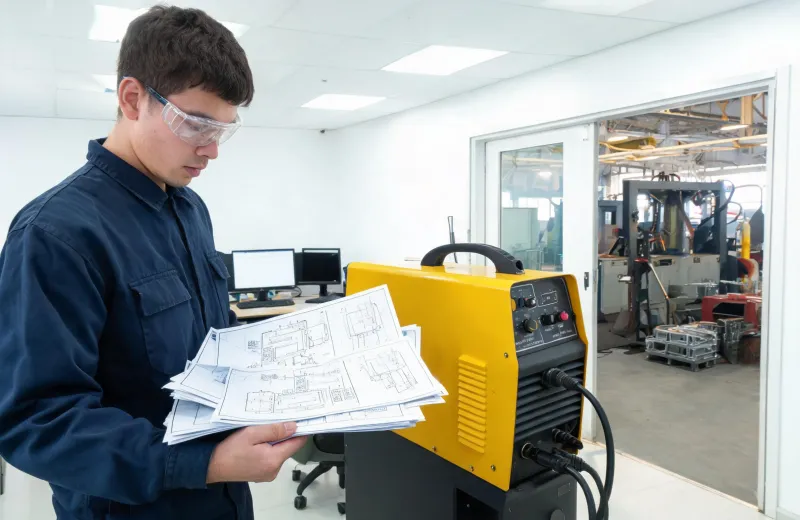
Application engineer reviewing a welding cell drawing
01

Application route

Use the form for equipment configuration, process comparison, automation interface questions and verification planning. Identify whether the work is production, repair, field installation, training or procedure development. A drawing or a concise joint description is more useful than a generic product request.

Response basis

Application scope and available documentation; no model claim is made before review.

02

Regional follow-up

Include the country or region so the request can be aligned with local supply, power, documentation and conformity needs. Dealer availability, service coverage and approved accessories vary by market, so regional confirmation is part of the selection record rather than an afterthought.

Contact channel

Submit the protected inquiry form below. Do not include passwords, payment-card details or export-controlled drawings.

03

Working window

State the date when a technical decision is required and the expected commissioning window. If production is already stopped, identify that condition clearly. Timelines depend on application complexity, test requirements, regional inventory and whether a WPS or customer approval process must be completed.

Useful attachments

Joint sketch, material specification, target weld size, current parameter sheet and acceptance criteria.

Two-column technical intake

Describe the operating envelope

For a repeatable comparison, name the base material and thickness range, then add the joint, position and acceptance method. If a process is already specified, include wire or electrode class, shielding arrangement and any heat-input limit. For plasma cutting, add plate type, thickness, desired edge condition, pierce requirement and available compressed-air quality.

Equipment has boundaries. Long cable runs can affect voltage delivery; unstable incoming power can change arc performance; high ambient temperature can alter thermal margin; aluminum feeding may require a different path than steel; and automated cells add communication, fixturing and safety-interface requirements. Recording those boundaries early reduces rework.

Verification pathRepresentative coupon → recorded settings → inspection result → documented approval.
Enter your name.
Enter a valid email address.
Enter your company name.
Describe the welding or cutting application.